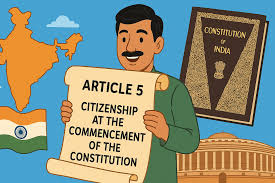
Constitution of India is the supreme law of the country. Among its initial provisions, Article 5 plays a crucial role in defining who became citizens of India at the time when the Constitution came into force on 26 January 1950.
This article laid the foundation for Indian citizenship immediately after independence and the partition of India.
🔹 Text of Article 5
Article 5 – Citizenship at the commencement of the Constitution:
At the commencement of the Constitution, every person shall be a citizen of India if they:
Have their domicile in the territory of India, and
Fulfill any one of the following conditions:
Born in India, or
Either parent was born in India, or
Has been ordinarily resident in India for at least 5 years before the commencement of the Constitution
🔹 Key Terms Explained
✅ Domicile
Domicile means a person’s permanent home where they intend to live permanently. It is not just temporary residence but a legal connection with a country.
✅ Ordinary Residence
This refers to living in India continuously for at least 5 years before 26 January 1950.
🔹 Important Conditions of Article 5
✔️ 1. Domicile is Mandatory
A person must have a domicile in India. Without domicile, citizenship under Article 5 is not granted.
✔️ 2. Birth or Parentage
Citizenship can be obtained if:
The person was born in India, or
At least one parent was born in India
✔️ 3. Residence Requirement
Even if not born in India, a person could become a citizen if they lived in India for 5 years before 1950.
🔹 Historical Context
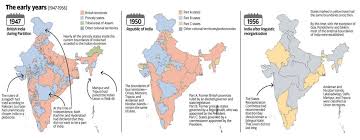
After the Partition of India in 1947, millions of people migrated between India and Pakistan. Determining citizenship became essential.
Article 5 ensured that people who had a strong connection with India were recognized as its citizens at the beginning of the Republic.
🔹 Importance of Article 5
🌟 1. Foundation of Citizenship
It provided the initial legal framework for identifying Indian citizens.
🌟 2. Stability After Independence
It helped maintain order during the chaotic post-partition period.
🌟 3. Basis for Future Laws
Later laws like the Citizenship Act, 1955 were built upon these principles.
🔹 Difference from Current Citizenship Laws
Article 5 only applied at the commencement of the Constitution (1950). Today, citizenship is governed by laws passed by Parliament, mainly the Citizenship Act, 1955.
🔹 Simple Example
A person born in India and living here in 1950 → Citizen ✅
A person whose parents were born in India → Citizen ✅
A person living in India for 5+ years before 1950 → Citizen ✅
🔹 Conclusion
Article 5 of the Indian Constitution was a crucial provision that defined who belonged to India at the birth of the Republic. It ensured that citizenship was granted based on domicile, birth, and residence, creating a strong legal identity for the people of India.
Technology
Article 5 of the Indian Constitution Explained – Citizenship at the Commencement of the Constitution
Tags
5,387
Views
422
Words
2 min read
Read Time
Apr 2025
Published